
Products

The modern lingerie landscape is shifting away from restrictive structuring toward intuitive, skin-first alternatives. For years, molded cups dictated the silhouette, but contemporary wardrobes demand something far more seamless and weightless. This is where fabric nipple covers have quietly revolutionized daily dressing, offering an elegant compromise between modesty and absolute freedom.
Unlike their heavy predecessors, these lightweight covers and specialized adhesive discs mimic the natural movement of the body, making them virtually undetectable under thin clothing. They represent a philosophical pivot in design, prioritizing the wearer’s sensory experience without sacrificing structural reliability.
To understand the appeal of a fabric surface, one must look at the structural limitations of pure silicone. While silicone excels at creating a smooth, rounded faux-cup shape, it behaves like an occlusive barrier on the skin, trapping heat and moisture. Fabric versions utilize advanced textiles such as premium microfibers, high-gauge woven polyester, or ultra-stretch Lycra blends. These materials possess inherent breathability, allowing micro-vapors from the skin to escape naturally throughout the day.
| Feature | Fabric Nipple Covers | Traditional Silicone Covers |
|---|---|---|
| Primary Material | Microfiber, Woven Cloth, Lycra | Solid Medical-Grade Silicone |
| Weight Profile | Ultra-lightweight, feather-thin | Substantial, adaptive weight |
| Breathability | High micro-porosity for airflow | Non-porous occlusive barrier |
| Edge Transition | Tapered, flush woven perimeter | Feathered polymer edge |
| Best Suited For | High-gauge knits, summer wear | Sheer tops, deep plunge necklines |
The physical profile of a woven cover is remarkably flat. Under a microscope, the edges of a high-quality woven cover reveal a precision-tapered transition that blends seamlessly into the torso. This cross-sectional architecture eliminates the dreaded “ridge effect” often seen when thick silicone discs press against fine, unlined silk or tissue-weight cotton tees. Furthermore, the textile face reduces friction against outer clothing, allowing blouses to drape naturally rather than catching on a tacky surface.
Silicone has its kingdom, particularly beneath heavy bridal satins or plunge gowns requiring dense structural smoothing. However, fabric alternatives claim victory the moment the temperature climbs or the wardrobe turns fluid. During peak summer heat, sweat behaves as a hydraulic lubricant, lifting solid silicone away from the body. Woven textiles absorb micro-droplets of moisture at the base layer, keeping the bond secure.
Consider the corporate environment, where a professional woman might wear a fine-gauge merino wool knit or a fitted modal turtleneck. A silicone cover can create a distinct, artificial circular protrusion under the tension of knitwear. Fabric discs conform to the natural anatomy, softening the apex without creating an artificial dome.
The stability of the adhesive under mechanical stress is a primary focus, ensuring that even when a textile flexes and stretches during light activity or a brisk commute, the bio-compatible glue maintains its grip without pulling at delicate skin cells.
Achieving an invisible, secure application requires treating the skin as a pristine canvas. The golden rule of adhesive intimate wear is the absolute elimination of surface lipids. Any trace of body oil, rich moisturizing cream, shower gel residue, or ambient sweat will compromise the polymer bond instantly.
When applied correctly, the medical-grade Germany Wacker adhesive reacts to body heat, creating a secure, flexible matrix. This bond withstands the natural shifting of the pectoral muscles throughout the day. Avoid shifting or repositioning the cover once it has made contact with the skin, as cross-contamination from skin flakes will degrade the adhesive matrix prematurely.
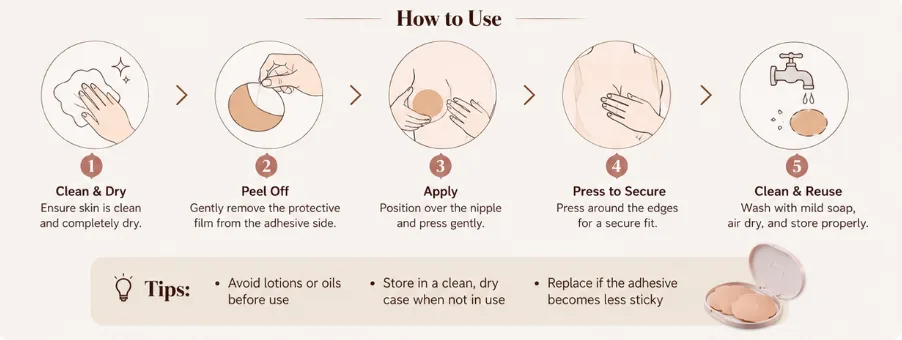
The longevity of a premium reusable adhesive item depends entirely on post-wear decontamination. Sweat, dead skin cells, and microscopic clothing fibers accumulate on the tacky surface, slowly insulating the glue from the skin.
Gently wash the adhesive side under lukewarm running water, applying a few drops of a neutral, fragrance-free liquid soap. Use the pads of your fingers in a gentle circular motion, avoiding the use of fingernails or abrasive sponges which can tear the thin adhesive layer. Rinse thoroughly until all soap residue is gone.
Air drying is non-negotiable. Suspend the covers in a dust-free indoor environment, away from direct sunlight or intense heat sources. Never use a towel, tissue, or hair dryer to dry the sticky surface, as this will permanently embed lint into the adhesive. Once completely dry, restore the original protective plastic backing film over the adhesive side to prevent airborne dust contamination, and store them flat in their original packaging.
By protecting the structural integrity of these reusable fabric nipple covers, you preserve their contouring performance, keeping your wardrobe effortless, comfortable, and flawlessly smooth for dozens of wears to come.
Curious about our quality? Request your free samples of nipple covers and sticky bras today. As a dedicated manufacturer, we provide unbeatable factory-direct pricing and service to ensure your brand’s success.

Dsaky
INQUIRY