
Products

The modern wardrobe is a study in architectural freedom. We chase the fluid drape of silk, the uncompromising line of a backless slip dress, and the second-skin embrace of fine-gauge knitwear. Yet, the traditional bra, with its industrial architecture of wires and foam, often acts as a visual disruption. This structural tension has transformed the humble silicone disc into an essential tool of contemporary dressing.
Choosing the right seamless nipple covers is no longer just about modesty. It is a calculated decision that balances material science with the precise demands of your personal style. For us, the stability of the adhesive under mechanical stress is a primary focus, ensuring that invisibility never compromises security.
The market generally diverges into two material pathways: medical-grade silicone and breathable performance fabrics. Each serves a distinct microclimate on the skin.
Silicone mimics the natural density of human tissue. High-quality variants leverage medical-grade formulations that respond dynamically to body heat, creating a cohesive bond without aggressive chemical tackiness. When using premium raw materials, such as Germany Wacker adhesive, the risk of epidermal irritation drops significantly. This hypoallergenic glue offers a reliable hold, even on sensitive skin or during humid summer transitions.
Fabric covers, conversely, utilize tightly woven, ultra-thin polymers. They excel in high-temperature environments where moisture management is paramount. While fabric allows sweat to evaporate efficiently, it lacks the structural opacity of silicone, which can occasionally fail to mask distinct textures under light-colored, single-ply garments.
Every garment demands a specific technical solution from your undergarments. A bias-cut silk dress, for instance, is notoriously unforgiving. It clings to the slightest protrusion, turning standard adhesive discs into visible circles. For these fluid textiles, a matte-finish silicone cover with an ultra-thin perimeter is non-negotiable.
+---------------------+-----------------------+-------------------------+
| Garment Type        | Recommended Material  | Key Feature Required    |
+---------------------+-----------------------+-------------------------+
| Bias-Cut Silk       | Matte Silicone        | Micro-tapered edges     |
| Heavy Knitwear      | Fabric / Silicone     | Structural opacity      |
| Plunging V-Neck     | Curved Matte Silicone | Secure peripheral bond  |
| Backless Summer     | Medical-Grade Glue    | High sweat resistance   |
+---------------------+-----------------------+-------------------------+
Deep plunging necklines and structural tailoring introduce a different challenge: lateral movement. As the torso twists, the garment shifts, meaning the adhesive must withstand shear stress. Here, the internal geometry of the cover matters. A slightly firmer core stabilizes the apex, while the flexible perimeter moves in tandem with the dermis, preventing the edges from lifting when you move.
True invisibility is achieved through structural graduation. Standard adhesive circles often possess uniform thickness, creating a blunt step where the product ends and the breast begins. Premium engineering relies on tapered edges. The center of the disc maintains enough thickness to ensure complete opacity, while the profile gradually thins down to a fraction of a millimeter at the margin. This creates a flawless, feather-light transition.
When selecting a size, do not look at your cup size alone. Consider the surface area of the areola and the natural curve of your breast. A cover that is too small will create a noticeable pinching effect at the borders. Conversely, an oversized disc might struggle to adhere smoothly across a highly contoured surface, leading to air pockets and eventual delamination.
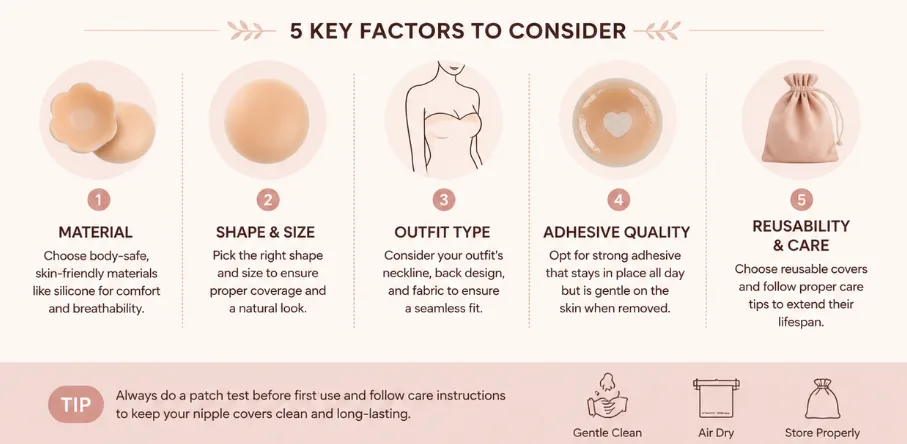
The longevity of high-end adhesive solutions rests entirely on post-wear maintenance. Sebum, dead skin cells, and microscopic fabric lint are the primary enemies of reusable polymers.
After each deployment, the covers should be rinsed in lukewarm water paired with a mild, neutral soap. Harsh detergents containing alcohol or heavy oils will degrade the chemical bonds of the adhesive matrix over time.
Air drying is the only acceptable method. Towels and tissues introduce debris that permanently compromises the tackiness. Once completely dry, returning the protective plastic film to the sticky surface prevents environmental dust from settling. Proper storage preserves the structural integrity of your seamless nipple covers, guaranteeing they remain an invisible, reliable ally in your wardrobe rotation for dozens of wears to come.
Curious about our quality? Request your free samples of nipple covers and sticky bras today. As a dedicated manufacturer, we provide unbeatable factory-direct pricing and service to ensure your brand’s success.

Dsaky
INQUIRY