
Products

Choosing the right minimal coverage can be deceptive. Many women stand in the lingerie aisle, deeply confused by the subtle distinction between pasties and nipple covers. They look similar, yet they perform very differently.
The confusion stems from a lack of standard industry definitions. Consumers often purchase based on aesthetics alone. Then, they suffer from unexpected skin irritation or sudden adhesive failure.
Every body deserves reliable, seamless coverage that feels like a second skin. Understanding the underlying material science changes everything. It transforms a risky purchase into a confident, long-term wardrobe investment.
For us, creating these intimate solutions is an exact science. We see how the right choice empowers daily movement. Let us dismantle the marketing noise and look at the actual physics of coverage.
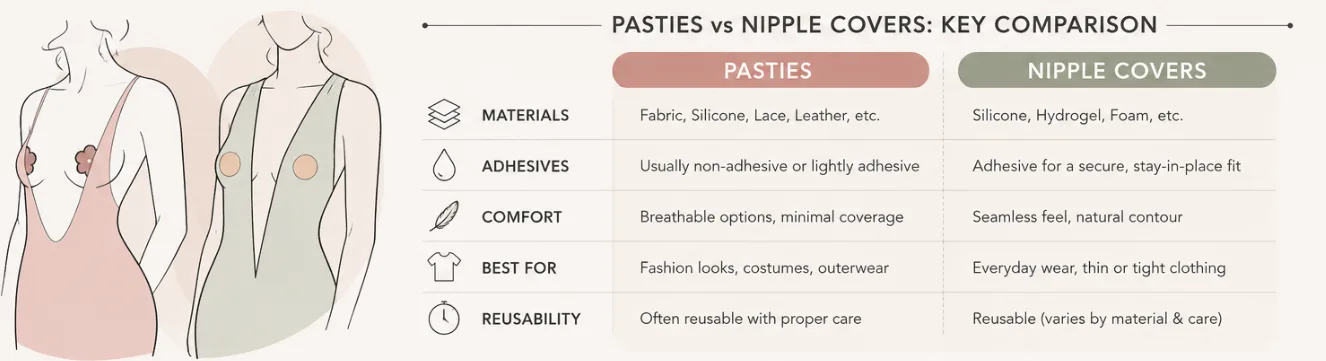
Silicone nipple covers are engineered to mimic human tissue perfectly. They leverage advanced polymers that adopt your body temperature within minutes. This creates an invisible, tapered edge that disappears under silk.
The secret lies in the molding process. High-quality silicone uses a graduated thickness profile. It is thickest in the center for coverage, thinning out to micro-millimeters at the perimeter.
| Feature | Medical-Grade Silicone | Non-Woven / Satin Fabric |
|---|---|---|
| Thickness Profile | Tapered edges | Uniformly flat |
| Reusability | Up to 50+ times | Single-use only |
| Visibility | Seamless under silk | May show edges |
| Best Suited For | Form-fitting attire | Loose, textured tops |
Fabric and paper pasties operate on a completely different philosophy. They rely on woven or non-woven fibers, offering maximum breathability. They do not trap heat, making them feel exceptionally lightweight.
However, fabric lacks structural depth. It cannot mask texture as effectively as a contoured silicone disc. Under thin white linen, a paper pastie might still betray its presence.
Skin on the breast is incredibly delicate and highly reactive. Prolonged occlusion—trapping moisture beneath a non-porous barrier—often triggers severe contact dermatitis. This is where cheap adhesives fail miserably.
Industrial glues contain harsh chemical solvents that leach into pores. When heated by body warmth, these compounds cause redness, itching, and painful peeling.
               [ Trapped Sweat & Heat ]
                         │
                         ▼
           [ Cheap Industrial Adhesives ]
                         │
                         ▼
        [ Chemical Leaching & Pore Occlusion ]
                         │
                         ▼
          [ Epidermal Redness & Irritation ]
To combat this, premium solutions utilize biocompatible, medical-grade pressure-sensitive adhesives. This includes advanced formulations like German Wacker silicone glue. It forms a secure mechanical bond without chemical aggression.
These hypoallergenic adhesives respect the lipid barrier of your epidermis. They release cleanly from the skin without tearing live cells. For us, prioritizing certified skin safety is the only acceptable manufacturing standard.
Summer heat introduces the ultimate nemesis of adhesive lingerie: sweat. When sweat glands activate, fluid builds up beneath the cover. This hydrostatic pressure pushes the adhesive away from the skin.
Traditional fabric pasties absorb this moisture directly. Consequently, the fabric becomes heavy, wet, and loses its structural integrity. The edges begin to curl outward.
Silicone covers do not absorb moisture; they repel it. However, trapped sweat can cause them to hydroplane. This causes the cover to slide out of its original position.
The solution lies in the quality of the adhesive matrix. Advanced cross-linked silicone adhesives maintain tackiness even when exposed to mild moisture. They ensure the perimeter remains anchored during a humid outdoor gala.
Reusable silicone models offer incredible longevity if maintained with precision. Sweat, dead skin cells, and lint gradually coat the adhesive surface. This buildup creates a barrier that prevents proper skin contact.
Washing them is remarkably simple but requires gentle care. Use lukewarm water and a drop of neutral, oil-free soap. Avoid harsh detergents that degrade the polymer structure.
Step 1: Rinse with lukewarm water.
Step 2: Apply mild, oil-free soap and wash gently using your fingertips.
Step 3: Rinse thoroughly to remove all soap residue.
Step 4: Air-dry in a dust-free environment, adhesive side up.
Step 5: Apply the original protective plastic film for storage.
Never use a towel to dry the adhesive surface. Air-drying prevents lint contamination completely. Once dry, the properties of the adhesive naturally regenerate.
Conversely, single-use paper pasties offer a distinct hygienic advantage during travel. You simply peel and discard them at night. This eliminates the need for maintenance in a cramped hotel sink.
Navigating the nuances of pasties vs nipple covers ultimately comes down to your outfit and skin type. By understanding these technical realities, you can move through the world with absolute, invisible confidence.
Curious about our quality? Request your free samples of nipple covers and sticky bras today. As a dedicated manufacturer, we provide unbeatable factory-direct pricing and service to ensure your brand’s success.

Dsaky
INQUIRY