
Products

The panic sets in slowly. You are dressing for a gala, an important corporate speech, or a summer wedding. Your favorite backless dress is ready. You peel off your reliable silicone covers, only to find they slip right through your fingers.
Dust, dead skin cells, and body oils have created an invisible, microscopic barrier over the adhesive surface. The grip is gone. This frustrating moment leaves every woman wondering how to make nipple covers sticky again without ruining the delicate medical-grade polymer.
| Dust & Fiber Accumulation | Creates a physical barrier over the glue |
| Sebum & Sweat Buildup | Neutralizes chemical bonding properties |
| Chemical Contamination (Perfume/Lotion) | Breaks down the long-chain silicone matrix |
Losing adhesion is not a product failure. It is basic physics. For us, manufacturing these intimate essentials for years has revealed that proper maintenance can easily extend a product’s lifecycle, saving consumers money and reducing wardrobe anxiety.
Understanding the mechanics of your second skin changes how you treat it. Let us look at what makes these little lifesavers work, and how to revive them when they fail.
Sticky bras do not use traditional wet glues. They rely on advanced pressure-sensitive adhesives (PSA). These are typically formulated from specialized, cross-linked silicone polymers.
The magic lies in viscoelasticity. The adhesive must act like a solid to stay in place, yet flow like a high-viscosity liquid to micro-mold into the unique texture of human skin.
When you press the cover onto your breast, Van der Waals forces activate at a molecular level. It is a delicate dance of physics.
[Skin Surface] <--- Van der Waals Forces ---> [Viscoelastic Silicone Glue]
Every time you wear them, your skin sheds thousands of microscopic cells. Sweat carries natural lipids.
These elements fill the tiny valleys within the silicone adhesive. The surface becomes smooth, flat, and completely unable to grab your skin.
Premium manufacturers utilize high-grade raw materials to combat this rapid degradation. For instance, blending specialized Germany Wacker adhesive helps the polymer matrix retain its structural memory far better than cheaper, industrial-grade alternatives.
Cheap silicone degrades permanently after a few washes. High-quality formulation allows the adhesive layer to reset once foreign particles are lifted away.
Restoring that original factory grip requires gentle, precise decontamination. You cannot throw these items into a washing machine or scrub them with a harsh bathroom towel.
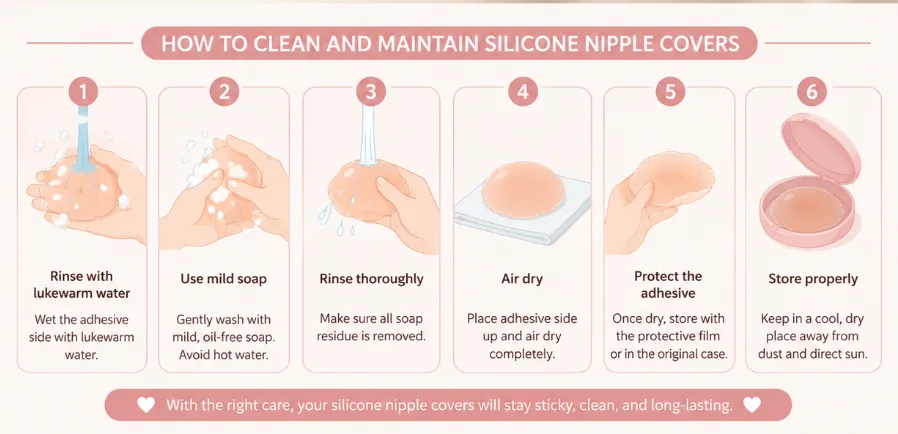
Follow this strict protocol to breathe new life into your dull adhesive layers:
Why avoid standard hand soaps or dish detergents? They often contain moisturizing creams, heavy essential oils, or aggressive surfactants.
Fragrant Soap Residues = Permanent Non-Stick Film
These chemical additives leave a microscopic film behind. Instead of cleaning the silicone, they coat it permanently, rendering the cover useless.
Treat your adhesive like a high-precision medical instrument. Gentle friction and pure water are your primary tools.
The cleaning process is only half the battle. How you dry the product determines whether it recovers its grip or becomes a magnet for airborne debris.
Air-drying is the golden rule. Find a dust-free indoor environment away from open windows, air conditioning vents, or heating units.
Place the covers sticky-side up on a clean, flat surface. A glossy ceramic plate or a laminated tray works beautifully.
As the water evaporates, the silicone molecules naturally realign. The sticky properties return.
Once the surface is completely bone-dry, immediately apply the original protective plastic films. This step keeps ambient dust from ruining your hard work.
Store them inside their original travel cases or boxes. This simple habit keeps your adhesive pristine for your next sudden wardrobe shift.
Even the most meticulous cleaning routine cannot fight physics forever. Every silicone product eventually reaches its natural end of life.
How do you know when a pair is truly dead? Look closely at the physical state of the materials.
| Sign of Aging | Structural Impact |
| Persistent Yellowing | Chemical oxidation of the silicone matrix |
| Edge Curling | Loss of structural tension; will lift under tight clothing |
| Texture Flaking | The adhesive layer is disintegrating from the base silicone |
If you wash your covers perfectly and they still slide off within an hour, the polymer has lost its elastic memory. It can no longer adjust to body heat.
For us, creating durable adhesive solutions means engineering products to survive dozens of consumer wash cycles. Yet, frequent friction takes a toll.
If your lifestyle demands constant use of backless attire, consider upgrading to high-performance varieties. Plus-size options or medical-grade formulations offer thicker adhesive layers that survive extended wear.
Investing in a premium pair ensures you are not constantly struggling with a failing product. Quality engineering gives you peace of mind when it matters most.
Keep them clean, dry them safely, and protect the surface. Knowing how to make nipple covers sticky again ensures you stay confident, supported, and elegant in any outfit you choose to wear.
Curious about our quality? Request your free samples of nipple covers and sticky bras today. As a dedicated manufacturer, we provide unbeatable factory-direct pricing and service to ensure your brand’s success.

Dsaky
INQUIRY