
Products

Finding the right support goes beyond just measuring band and cup size. Many women with a fuller bust encounter issues with asymmetry or localized volume loss, making standard sizing inadequate. Addressing these nuanced fit challenges often requires more targeted adjustments than adjusting straps or switching styles. Specifically, utilizing bra inserts for large breasts offers a practical mechanism for correcting fit disparities and enhancing comfort without the need for bespoke undergarments.
A common misconception is that padded enhancements are solely for volume addition in smaller cup sizes. However, fuller profiles experience specific gravitational and tissue distribution changes that necessitate focused support.
The physics of a heavier bust means that tissue settles differently, especially after weight changes or breastfeeding. Standard cups, molded to uniform hemispherical shapes, rarely match natural contours perfectly.
This discrepancy leads to empty spaces within the cup, causing the fabric to wrinkle or the underwire to shift uncomfortably against the ribcage.
Understanding how to leverage inserts involves recognizing the specific structural deficit in your current fit.
Breast asymmetry is practically universal. When the size difference exceeds a half-cup, the resulting fit problems become pronounced, especially in structured undergarments. The larger side dictates the cup size requirement, inevitably leaving the smaller side lacking support and prone to gaping.
Attempting to fix this by tightening the strap on the smaller side usually pulls the band out of alignment. This strains the shoulder and back muscles unevenly.
Instead, placing an insert on the smaller side fills the void, equalizing the volume and allowing the garment to function symmetrically.
The density of the chosen insert matters here.
For fuller busts, the insert needs enough structural integrity to hold its shape against the existing tissue without collapsing.
Volume loss often occurs at the top of the breast—the upper pole—while the lower pole remains heavy. This results in a “teardrop” shape that many full-cup styles fail to accommodate properly.
When the upper cup is empty, the garment fails to provide the necessary upward lift, relying entirely on the lower cup and wire.
Positioning an insert at the bottom or slightly toward the outer edge of the cup pushes the existing tissue upward and inward.
This displacement shifts the volume back into the upper pole, filling the cup appropriately and restoring the intended silhouette of the garment.
It changes the vector of support from merely holding weight underneath to actively shaping it.
Not all inserts are created equal, and material choice directly impacts performance, particularly under the stress of a heavier bust.
For us, developing solutions involves rigorous testing of material safety and durability. Using medical-grade silicone ensures the insert maintains its structural integrity and remains hypoallergenic, crucial when positioned against sensitive skin for extended periods.
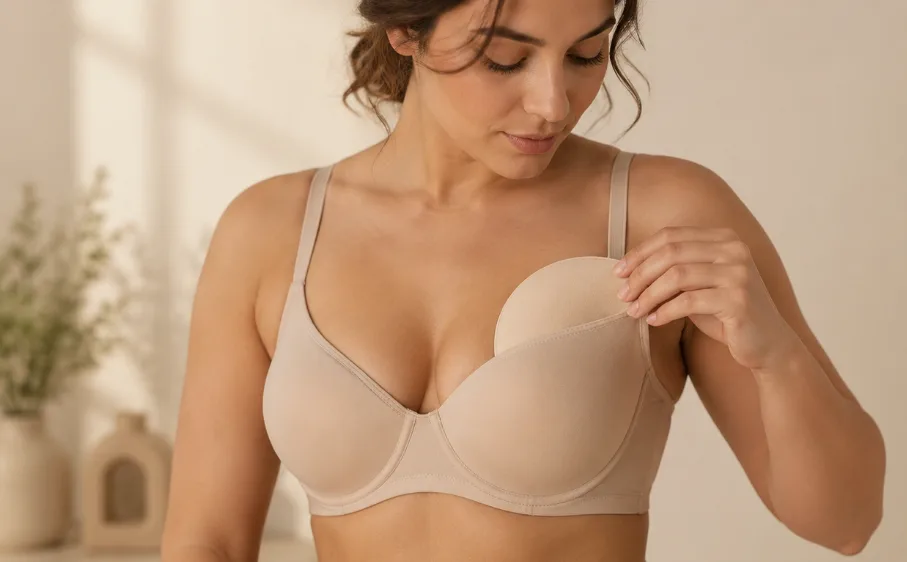
The efficacy of an insert relies entirely on its placement relative to the specific fit issue. Throwing a pad into the bottom of a cup won’t fix a lateral gaping problem.
If the goal is to correct side-spill or widen the cleavage, place the insert along the outer edge of the cup, near the underarm. This forces the tissue inward.
To address bottom-heavy shapes and create upward lift, position the insert securely at the base of the cup, resting just above the underwire.
If asymmetry is the primary concern, simply place the insert directly where the cup gapes most prominently on the smaller side.
When introducing silicone or dense foam against the skin, especially within the confined space of a structured undergarment, breathability and hygiene become critical.
Sweat accumulation can degrade adhesive properties (if using stick-on variants) and irritate the skin.
Wash inserts with mild soap and water after every use, allowing them to air dry completely. Never use harsh chemicals or abrasive materials, as these will destroy the surface integrity of silicone.
If using adhesive inserts, ensure the skin is completely dry and free of lotions or oils before application.
Disclaimer: The material care guidelines mentioned are based on standard silicone maintenance protocols. Individuals with specific skin sensitivities should consult a dermatologist regarding prolonged contact with synthetic materials.
Ultimately, bra inserts for large breasts are not about conforming to an idealized shape, but rather engineering a garment to function correctly for your specific physiology. By treating fit issues mechanically—filling voids, equalizing volume, and directing tissue—you can achieve the support and comfort that standard sizing alone often fails to deliver.
Curious about our quality? Request your free samples of nipple covers and sticky bras today. As a dedicated manufacturer, we provide unbeatable factory-direct pricing and service to ensure your brand’s success.

Dsaky
INQUIRY