
Products

Supporting a fuller bust without the traditional framework of underwires and shoulder straps presents a significant mechanical challenge. Traditional lingerie relies on a tension-based system where the band provides approximately 80% of the support. When that band is removed for backless or strapless designs, the physics of support must shift from tension to surface adhesion and structural reinforcement. For those seeking a plus size adhesive bra, the requirements for load distribution and skin safety are exponentially higher than for smaller cup sizes.
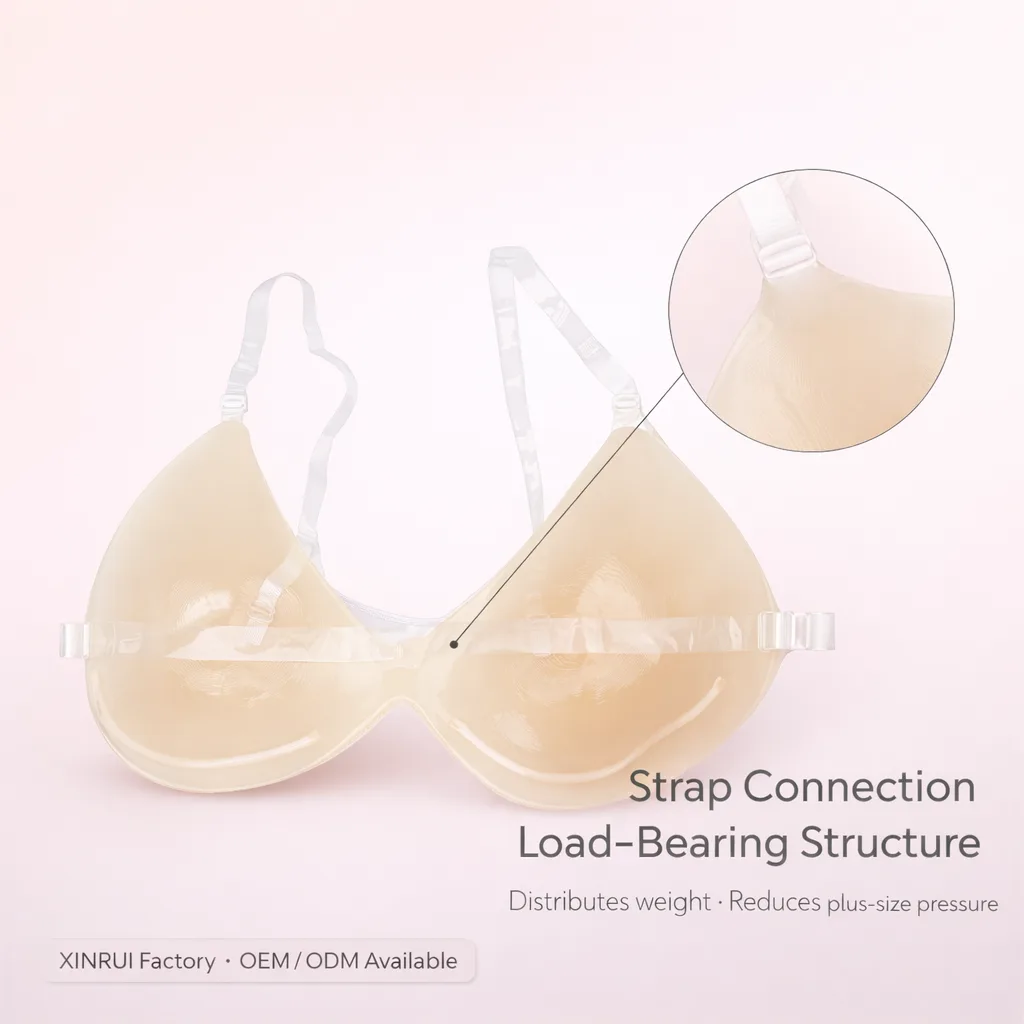
The primary hurdle in designing for D-I cup sizes is the gravitational downward pull. Standard sticky bras often fail because they lack a centralized load-bearing point. Modern high-capacity solutions address this through a reinforced center heart connector. This bridge acts as a stabilizer, preventing the two independent cups from splaying outward under weight. By locking the cups into a fixed geometry, the bra creates a unified support structure that mimics the stability of a front-closure traditional bra.
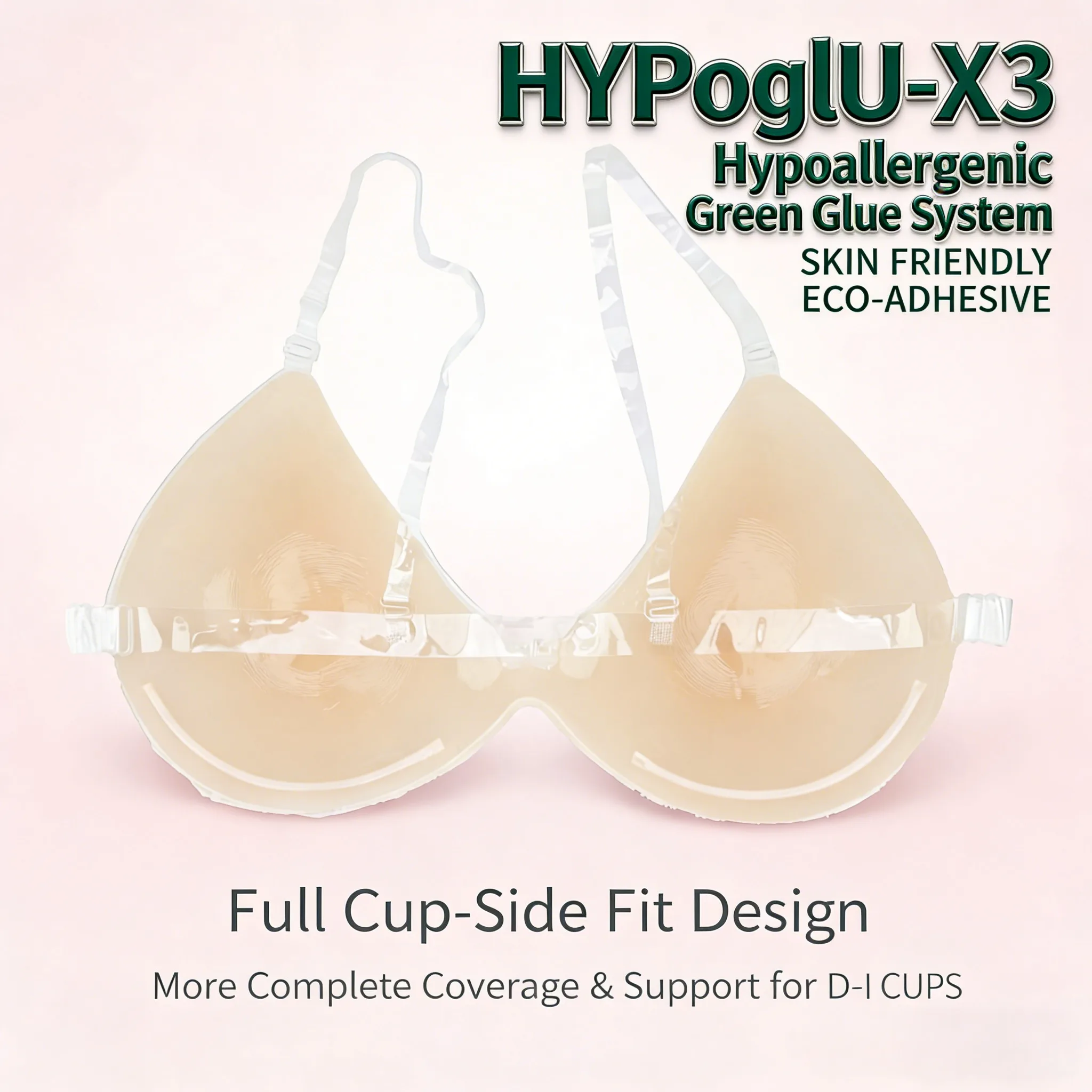
Beyond the connector, the cup shape itself is a functional component. A waterdrop-shaped design is not merely for aesthetics; the extended vertical surface area allows for a larger contact patch at the top of the breast. This is critical for creating an upward lift. When the adhesive surface area is maximized in these upper regions, the “peel force” required to dislodge the bra is significantly increased, providing a more secure hold during movement.
A plus size adhesive bra is only as reliable as its chemical interface with the skin. High-tension environments generate heat and moisture, which are the natural enemies of standard adhesives. To solve this, technical designs now incorporate proprietary systems like HypoGlu-X3. This is a medical-grade, pressure-sensitive adhesive (PSA) engineered to maintain high shear strength even when exposed to perspiration.
| Parameter | Specification | Functional Value |
|---|---|---|
| Material Base | Medical-Grade Silicone + TPU | Bio-compatibility and tensile strength |
| Adhesive Tech | HypoGlu-X3 Polymer | Sweatproof and 30+ times reusable |
| Size Range | D to I Cup | Optimized for high-volume support |
| Cup Dimensions | 37cm (W) x 20cm (H) | Maximum surface area coverage |
The “breathability” of these materials is often misunderstood. While silicone itself is occlusive, the integration of thin TPU (Thermoplastic Polyurethane) layers allows for a degree of flexibility that prevents the “stiff-plate” effect. This flexibility ensures that as the wearer moves, the bra deforms with the body rather than pulling away from the skin at the edges.
In professional or high-stakes environments—such as wedding ceremonies or gala events—the risk of adhesive failure is a primary concern. Most failures occur not because the adhesive is “weak,” but because the surface preparation or application angle was incorrect. For a plus size adhesive bra to function optimally, the skin must be entirely free of lipids (oils) and moisturizers.
We have observed that the most effective application method involves a “bottom-up” roll. By adhering the lower portion of the cup first and then pulling the upper “tail” of the waterdrop shape upward before smoothing it down, the user creates a pre-tensioned state. This pre-tensioning effectively fights gravity from the moment of application.
Why does the adhesive feel less tacky after several uses? This is typically due to the accumulation of skin cells and sebum on the polymer surface. Because the material is non-porous, these contaminants create a barrier. For us, maintaining reusability means advocating for a simple rinse with neutral soap, which restores the chemical surface energy of the adhesive.
Can these bras handle high-humidity outdoor events? Yes, provided the adhesive is a sweat-resistant variant. The HypoGlu-X3 system we utilize is tested for moisture resistance. However, it is vital to apply the bra to bone-dry skin. Once the bond is established, it remains stable even if the wearer begins to perspire later.
Is there a risk of skin irritation with long-term wear? While no adhesive is 100% universal, medical-grade silicones are designed to be inert. The “irritation” users sometimes report is often mechanical (from improper removal) rather than chemical. Always peel the bra slowly from the top down to minimize stress on the epidermis.
The shift toward high-performance adhesive solutions is driven by a need for invisibility without sacrificing security. By focusing on the intersection of polymer science and structural geometry, it is now possible to provide a plus size adhesive bra that offers genuine utility. The goal is a solution that remains unnoticed by the observer while providing a sense of total security for the wearer, effectively solving the “backless dilemma” for fuller figures through rigorous engineering rather than marketing fluff.
Curious about our quality? Request your free samples of nipple covers and sticky bras today. As a dedicated manufacturer, we provide unbeatable factory-direct pricing and service to ensure your brand’s success.

Dsaky
INQUIRY