
Products

It happens every time you wash your swimwear. The padding falls out. You pick up those foam triangles, and you ask yourself regarding a swimsuit which way do bra inserts go? It seems like a minor detail, yet getting it wrong changes the entire fit of your top.
A swimsuit insert is rarely perfectly symmetrical. Most feature a thicker section and a tapered edge. The orientation of that thickness dictates the support you receive. Placing them incorrectly creates awkward lumps, or it results in zero support for your chest. Let’s break down the mechanics of proper placement.
Grab one of your inserts, and take a moment to feel the edges. You will notice distinct variations in thickness across the surface.
The golden rule depends entirely on what you want the insert to achieve. For most standard triangle pads, the thickest part goes directly at the bottom.
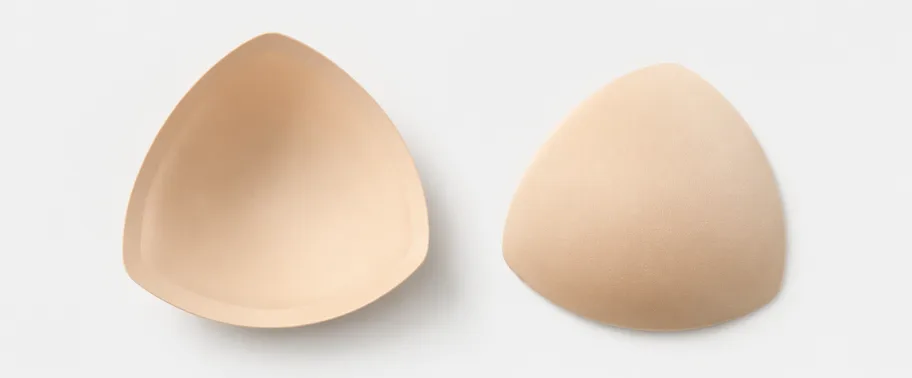
When you want upward lift, gravity is the main adversary you must fight. The padding needs to act as a solid shelf. Insert the pad so the thickest section sits at the base of the cup. The thin point should aim up toward the shoulder strap.
This specific setup pushes the breast tissue upward gently. It fills out the top of the swimsuit perfectly. It prevents the fabric from looking completely empty, or sagging awkwardly when it gets wet in the pool.
Sometimes you care significantly less about vertical lift, and you care much more about center fullness. This specific requirement demands a slight rotation of the foam pad.
Rotate the insert so the thickest part rests against the outer edge of the cup, positioning it near your underarm. The thinner section should point inward, aiming directly toward your sternum.
This inward pressure pushes the delicate tissue toward the center. It creates a highly natural-looking cleavage line. This technique works exceptionally well in deep-V necklines, or when you are wearing strapless bandeau tops.
| Goal | Thick Edge Placement | Thin Edge Placement | Best Swimsuit Style |
|---|---|---|---|
| Maximum Lift | Bottom of the cup | Pointing up to shoulder | Triangle tops, Halters |
| Cleavage | Outer edge near underarm | Pointing inward to sternum | Deep-V, Bandeaus |
| Natural Shape | Centered at the bottom | Blending into top edges | Sport tops, One-pieces |
Many pads unfortunately lack distinct printed labels for the left and right sides. The actual curvature of the foam is your absolute best indicator here.
If you happen to insert them backwards into the fabric pocket, you will undoubtedly see a noticeable ridge protruding through the outer layer.
Water weight absolutely changes everything about how a garment fits. A perfectly placed pad on dry land might migrate entirely to your collarbone, especially after getting hit by a single ocean wave.
To prevent this annoying shifting, ensure the fabric pocket is not overly stretched out. Some modern swimsuits have tiny hidden slits specifically for the padding. If the pad rolls up, gently flatten it out while you are wearing the suit.
Reach inside the small pocket, and gently smooth the edges down flat. For those who constantly struggle with relentless movement, a few basic stitches can solve the problem permanently.
Sewing the corners of the pad directly to the inner lining keeps them securely locked in position. For us, maintaining the fundamental structural integrity of swimwear is absolutely essential for long-term comfort.
Several visual signs quickly indicate that your padding is incorrectly positioned. Recognizing these early signs can save you from constant poolside adjustments.
If you experience any of these frustrating issues, take the swimsuit off immediately. Remove the pads entirely from the pockets, and calmly start the process over.
Wet nylon fabric clings entirely differently than dry fabric does. Adjusting these hidden inserts while the material is damp is often significantly harder.
Disclaimer: The garment care advice provided in this article is based on general textile knowledge and is for reference only. For specific swimsuit materials, please consult the manufacturer’s care tag.
Heavy washing machines are notoriously famous for destroying delicate foam inserts. They very often emerge folded perfectly in half, complete with a permanent structural crease. The cost here isn’t monetary, but rather a visual cost to your silhouette.
A deeply creased pad will never sit completely right, regardless of which exact way it goes. To effectively fix this, soak the damaged pad in warm water for several minutes.
Gently press it totally flat under a heavy book until it is dry. Alternatively, applying low-heat steam from an iron can help relax the dense foam. Do not press the hot iron directly onto the synthetic material.
Understanding exactly swimsuit which way do bra inserts go ultimately comes down to basic geometry. Find the thickest part of the padding immediately. Decide if you currently need upward vertical support, or inward center pressure.
Place the foam volume exactly where your body needs it the most. Small geometric adjustments always make a massive difference in how confident you feel in the water.
Curious about our quality? Request your free samples of nipple covers and sticky bras today. As a dedicated manufacturer, we provide unbeatable factory-direct pricing and service to ensure your brand’s success.

Dsaky
INQUIRY