
Products

The mechanics of strapless support demand a radical departure from traditional lingerie design. When the stabilizing force of a back band and shoulder straps is removed, the entire burden of lift transfers to the skin-to-cup interface. Navigating this transition requires a rigorous understanding of an accurate sticky bra size chart. Finding the correct strapless sticky bra sizing ensures that the counter-rotational forces of breast weight do not compromise the polymer bond, preventing sudden delamination during movement.
Traditional brassieres rely on a perimeter matrix. The band provides roughly eighty percent of the total support, anchoring the garment against the ribcage while the underwires distribute the vertical load. A stick-on silicone solution operates on a completely localized architecture. There is no external anchor point, meaning the cup itself must serve as both the container and the structural crane.
Standard sizing metrics fail here because they assume a static distribution of tissue across a rigid wire hemisphere. In adhesive engineering, we view the breast not as a fixed volume, but as a fluid mass that must be gathered, compressed, and shifted upward. If a consumer selects their size based purely on their standard daily underwear, the result is frequently catastrophic slippage, as the weight vectors pull downward and outward, peeling the adhesive edge away from the epidermis.
The total holding power of a pressure-sensitive adhesive is directly proportional to the square millimeters of skin it securely covers. A deeper cup might accommodate volume, but if the perimeter flange is too narrow, the shear stress at the upper edge will cause the silicone to release. For fuller figures, a standard cup profile lacks the necessary surface area to distribute mass effectively. The center of gravity shifts too far forward, creating a leverage effect that breaks the vacuum seal. Specialized manufacturers therefore expand the outer wing profile rather than just deepening the bowl, neutralizing the peeling force with a broader adhesive plane across the infra-clavicular zone.
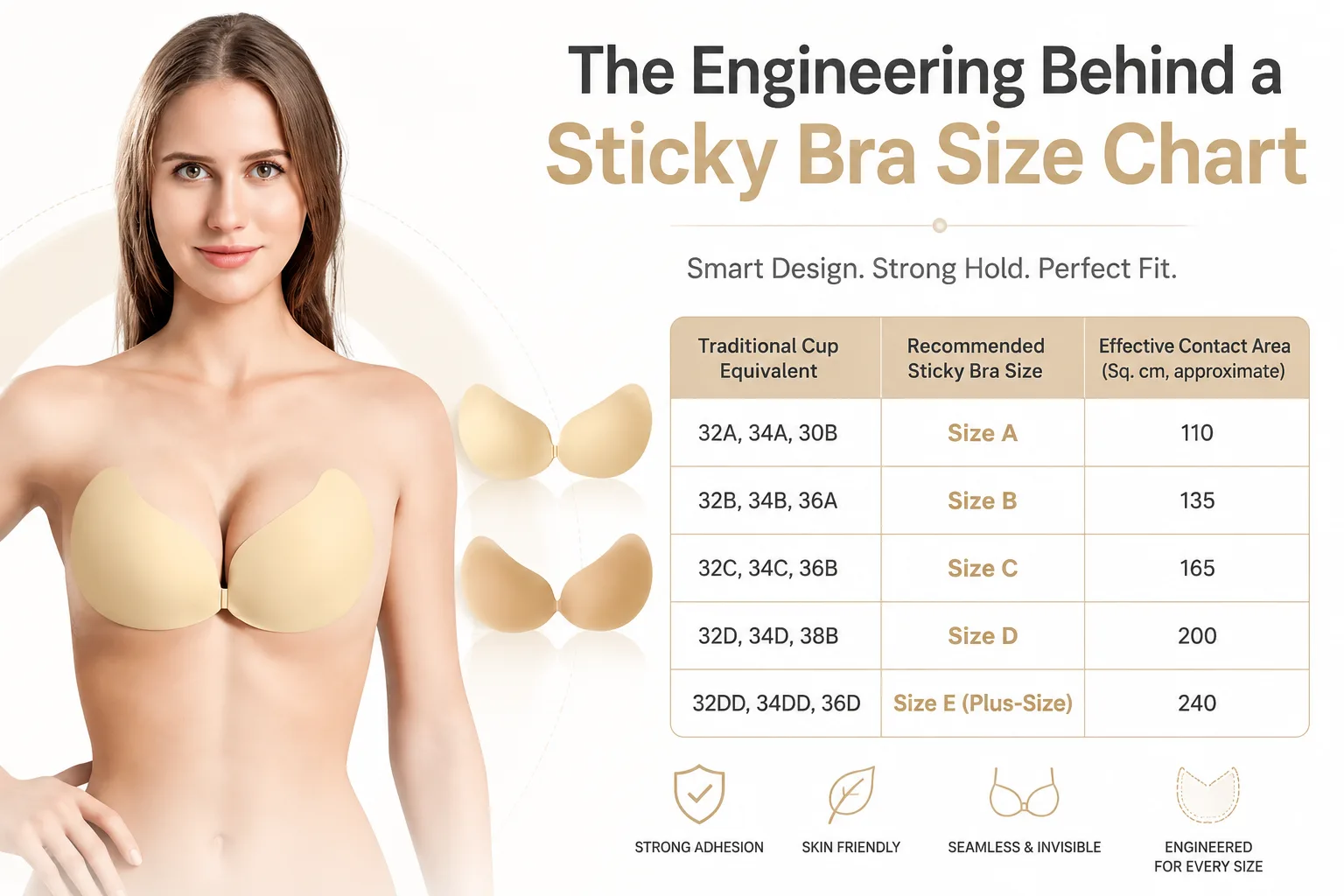
| Traditional Cup Equivalent | Recommended Sticky Bra Size | Effective Contact Area (Sq. cm, approximate) |
|---|---|---|
| 32A, 34A, 30B | Size A | 110 |
| 32B, 34B, 36A | Size B | 135 |
| 32C, 34C, 36B | Size C | 165 |
| 32D, 34D, 38B | Size D | 200 |
| 32DD, 34DD, 36D | Size E (Plus-Size) | 240 |
Multi-fit charts are calculated volume brackets. Because a backless garment lacks an adjustable closure, band variations like a 32D and a 36B must often share a single structural cup volume, requiring precise sister-size understanding. A universal chart bridges these gaps by factoring in the horizontal spread of tissue when uncompressed. For instance, a 34C requires the same volumetric container as a 32D, but the 32D needs a different application angle to maximize the contact patch. The chart functions as a geometric blueprint, mapping how the cohesive gel interfaces with varying ribcage curvatures.
The choice between polyurethane foam and molded silicone involves a direct trade-off. Polyurethane options are lightweight, reducing the gravitational pull on the adhesive, which makes them ideal for smaller volumes. However, they lack the structural density to reshape heavier tissue. Medical-grade silicone mimics the natural density of human tissue, offering a seamless silhouette, but solid silicone adds its own weight. For larger profiles, the adhesive formula must feature high green strength—the immediate bond upon initial contact—to counteract both the biological weight and the weight of the polymer cup itself.
Breast morphology—whether teardrop, slender, or asymmetric—profoundly alters product performance. A user with a shallow upper pole requires a different application technique than one with full omega-shaped breasts, even if they share an identical spot on a backless strapless bra size chart. True security comes through application mechanics. Angling the cups outward before pulling them together creates a lateral vector that locks the tissue into a lifted position, transforming the product from a simple cover into an active structural support system. For global brands, partnering with a certified facility that utilizes hypoallergenic Germany Wacker adhesive ensures that every step on the sticky bra size chart translates directly to flawless real-world performance.
Curious about our quality? Request your free samples of nipple covers and sticky bras today. As a dedicated manufacturer, we provide unbeatable factory-direct pricing and service to ensure your brand’s success.

Dsaky
INQUIRY