
Products

Securing proper garment fit often relies on invisible structural support beneath the fabric. Standard padding frequently shifts under physical movement, breaking the silhouette. Traditional solutions rely on tight garment bands to hold pads in place, which creates uncomfortable skin friction.
This is where double-sided sticky bra inserts fundamentally change the mechanical equation. By creating a temporary, stable bond between both the skin and the interior fabric, they eliminate internal friction and unwanted displacement.
A common failure point in conventional padding is shear force. As the body moves, the fabric slides across the exterior of the pad. A single-sided adhesive secures the pad to the skin but leaves the fabric free to rub. This constant friction eventually compromises the bond.
Double-sided adhesive layers solve this specific mechanical issue. By anchoring the pad to both the epidermis and the interior textile, the entire system moves as a single unified unit.
The adhesive used must balance high bonding strength with dermal safety. Medical-grade formulations are critical in this application. They maintain high surface tackiness in warm, humid microclimates without causing contact dermatitis or blocking pores.
Enclosing the chest area with non-porous materials naturally traps body heat. A poorly designed pad accelerates sweat production, rapidly degrading adhesive performance. The architecture of a functional insert must account for breathability and thermal management.
The core matrix combines soft silicone with a thermoplastic polyurethane (TPU) outer layer. This composite structure closely mimics the natural density of human tissue. The high-resilience internal material absorbs kinetic energy from movement, preventing structural collapse over hours of wear.
Unlike stiff foam alternatives, this silicone-TPU blend conforms dynamically to the chest wall. It ensures that physical pressure is distributed evenly across the surface area, avoiding localized pressure points that cause fatigue.
A blunt edge on an insert creates a visible ridge visible through thin clothing. This optical failure defeats the purpose of wearing concealed support. To achieve an invisible transition, the physical geometry must taper precisely.
The central zone maintains an approximate 3cm thickness to provide necessary volume and structural lift. From this apex, the material gradients down to an ultra-thin perimeter. This tapering allows the edge to sit completely flush against the skin.
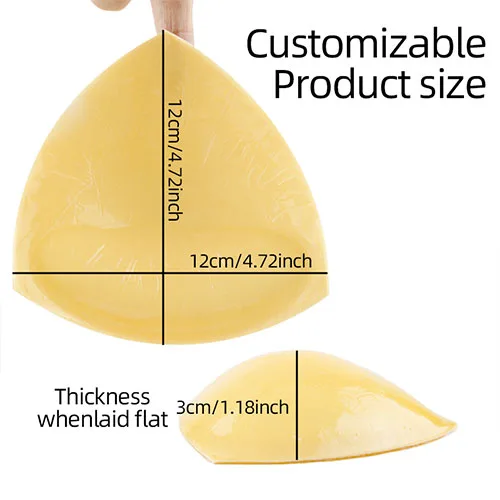
This specific geometry, measuring 12cm by 12cm in a full cup design, covers sufficient surface area to support A through D cup volumes. It successfully prevents the padding from creating unnatural contours beneath tight-fitting apparel.
Understanding the physical properties helps determine the appropriate application for these inserts.
| Specification | Detail |
|---|---|
| Material Base | Silicone + TPU |
| Dimensions | 12cm x 12cm |
| Maximum Thickness | Approx. 3cm |
| Adhesive Type | Medical-grade double-sided |
| Shape Architecture | Triangular full cup |
| Care Protocol | Hand wash only |
The physical orientation of the pad dictates the structural outcome. Users often incorrectly assume a single placement method works for all garments. Basic physics dictates otherwise.
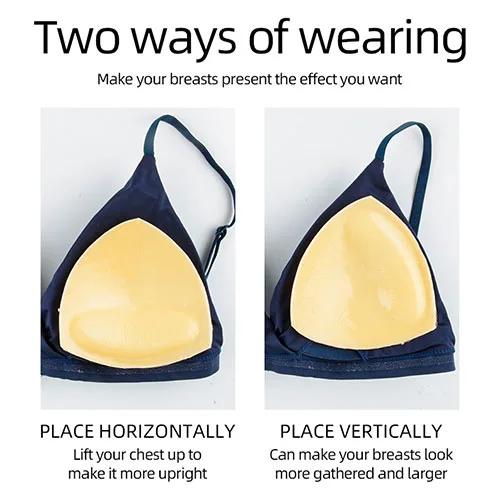
Adjusting the angle alters the force vectors applied to the bust:
How does sweat affect the double-sided bond? Excessive moisture can interfere with surface tension. The medical-grade adhesive resists moderate perspiration, but heavy physical exertion will temporarily weaken the bond until the surface area dries completely.
Will the outer adhesive damage delicate fabrics? The external adhesive layer is formulated to grip textile fibers without leaving chemical residue. Users should detach the pad slowly from fragile materials like silk to prevent mechanical stress on the weave.
Delivering reliable structural support requires strict tolerances during production. Variations in material density or adhesive coating thickness inevitably lead to uneven performance in the final application.
For us, producing reliable sticky bra inserts involves rigorous testing of medical-grade silicone and hypoallergenic glues. By relying on standardized processes and automated production lines, we ensure every unit maintains consistent adhesive strength and physical integrity for dependable everyday wear.
Curious about our quality? Request your free samples of nipple covers and sticky bras today. As a dedicated manufacturer, we provide unbeatable factory-direct pricing and service to ensure your brand’s success.

Dsaky
INQUIRY