
Products

Many women struggle with backless garments because gravity inevitably challenges unsupported tissue. Finding a reliable lifting sticky bra remains a practical problem for styling open-back dresses.
The core issue lies in the absence of mechanical tension. Without shoulder straps pulling upward or a rigid band anchoring the ribs, breast tissue naturally drops.
This guide examines how structural design and chemical adhesion work together. We will explore how modern engineering counteracts that downward force.
Conventional strapless undergarments rely entirely on the underbust band for friction. If the band slips even a fraction of an inch, the cup loses its structural integrity.
When dealing with heavier breast tissue, the horizontal tension of a standard band is rarely enough to provide vertical lift. The weight acts as a lever, pushing the front of the bra down.
Adhesive options change this physics model entirely. Instead of relying on a tight band squeezing the torso, they bond directly to the skin surface to distribute the weight.
A lifting adhesive undergarment does not just stick to the front of the breast. It utilizes upward pulling angles, often anchoring higher on the chest or incorporating a front clasp.
When you pull the cups together and secure a central clasp, you create a tension bridge. This bridge gathers the tissue toward the center, mimicking the side-support of a wire.
Some designs feature extended top tabs. These tabs act like a cantilever in architecture, shifting the weight distribution upward and spreading the load across a larger dermal area.
Selecting the appropriate material configuration dictates both the visual outcome and the maximum weight support limit for your specific garment type.
| Material Type | Weight | Breathability | Primary Function | Best For |
|---|---|---|---|---|
| Medical-Grade Silicone | Heavier | Low | Seamless concealment, skin-like texture | Bodycon dresses, smooth fabrics |
| TPU / Fabric Blend | Lighter | Moderate | Sheer vertical lift without bulk | Large busts, structured outfits |
Circular cups provide balanced coverage but lack the geometric angles required to shift heavy tissue. They focus entirely on concealing the front of the breast without altering its natural placement.
Mango-shaped or teardrop designs serve a different functional purpose. The tapered edges of these shapes point toward the collarbone, creating an artificial lifting vector that mimics a physical strap.
Deep U-plunge structures require even stronger adhesives. Because the center bridge sits extremely low, all the lifting mechanics depend on the outer wings gripping the sides of the torso.
Sweat is the natural enemy of any glue. Moisture breaks the chemical bond between the adhesive polymer and your epidermis, leading to sudden and catastrophic failure.
For us, manufacturing adhesive solutions over the past 18 years means prioritizing medical-grade raw materials. High-quality hypoallergenic glues maintain their tackiness even when core body temperature rises slightly.
However, excessive sweat will eventually cause peeling. Preparing the skin by stripping away lotions, body oils, and moisture before application is mandatory for a secure hold.
Edge curling occurs when the cup size does not match the breast volume. If the silicone curve is shallower than the natural tissue, physical tension slowly pries the edges away from the skin.
Micro-sweating is another frequent culprit for sudden release. Even if you feel dry in an air-conditioned room, anxiety or sudden movements can trigger microscopic sweat responses beneath the impermeable silicone layer.
Taking brief cooling breaks in restrooms helps manage core temperature. Pressing the skin gently around the edges can prevent moisture from breaking the central polymer bond during long events.
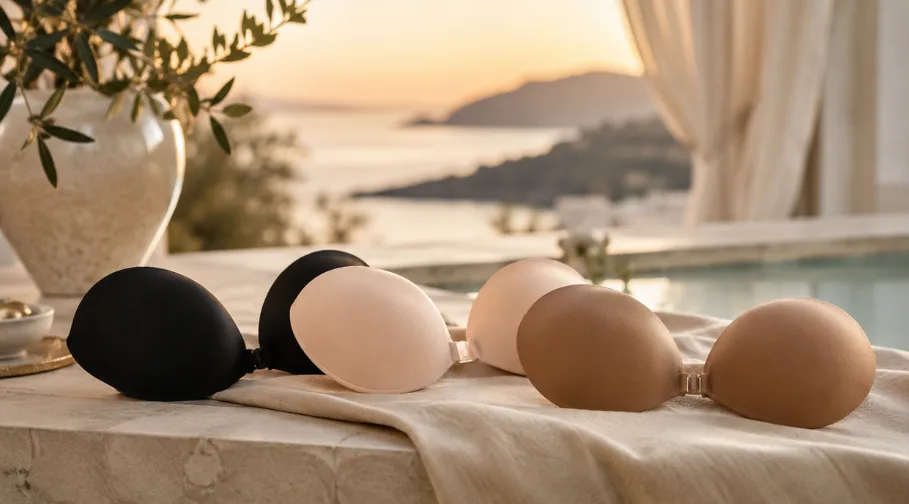
Slapping the cups on straight will provide coverage but zero elevation. The angle of application dictates the final resting position of the tissue.
To achieve proper vertical elevation:
This sequence forces the adhesive to lock the tissue in an elevated state. A lower placement angle directly results in a stronger upward pull.
Dust and dead skin cells coat the adhesive surface during use. This microscopic debris blocks the glue molecules from making contact with your skin during the next wear.
Washing the cups requires nothing more than mild soap and the pad of your thumb. Using fingernails or rough sponges will permanently scar the delicate adhesive coating.
Disclaimer: The cleaning and skin preparation advice provided in this article is based on general material care knowledge and is for reference only. Individuals with sensitive skin should perform a patch test before prolonged use.
Once rinsed, the lifting sticky bra must air dry in a dust-free environment. Replacing the original protective film guarantees the polymer remains active for your future styling needs.
Curious about our quality? Request your free samples of nipple covers and sticky bras today. As a dedicated manufacturer, we provide unbeatable factory-direct pricing and service to ensure your brand’s success.

Dsaky
INQUIRY