
Products

The relationship between water and standard adhesives is traditionally adversarial. When a swimmer dives into a pool, fluid dynamics instantly challenge anything attached to the skin. Standard strapless undergarments fail because water lubricates interfaces, breaking the molecular bonds of everyday glues. To overcome this, finding a reliable waterproof sticky bra for swimming requires a deep understanding of material science. It is not merely about making a product sticky. It is about understanding how materials interact with water molecules under active physical pressure. For us, the stability of the adhesive under mechanical stress is a primary focus, ensuring the integrity of the boundary layer remains intact during immersion.
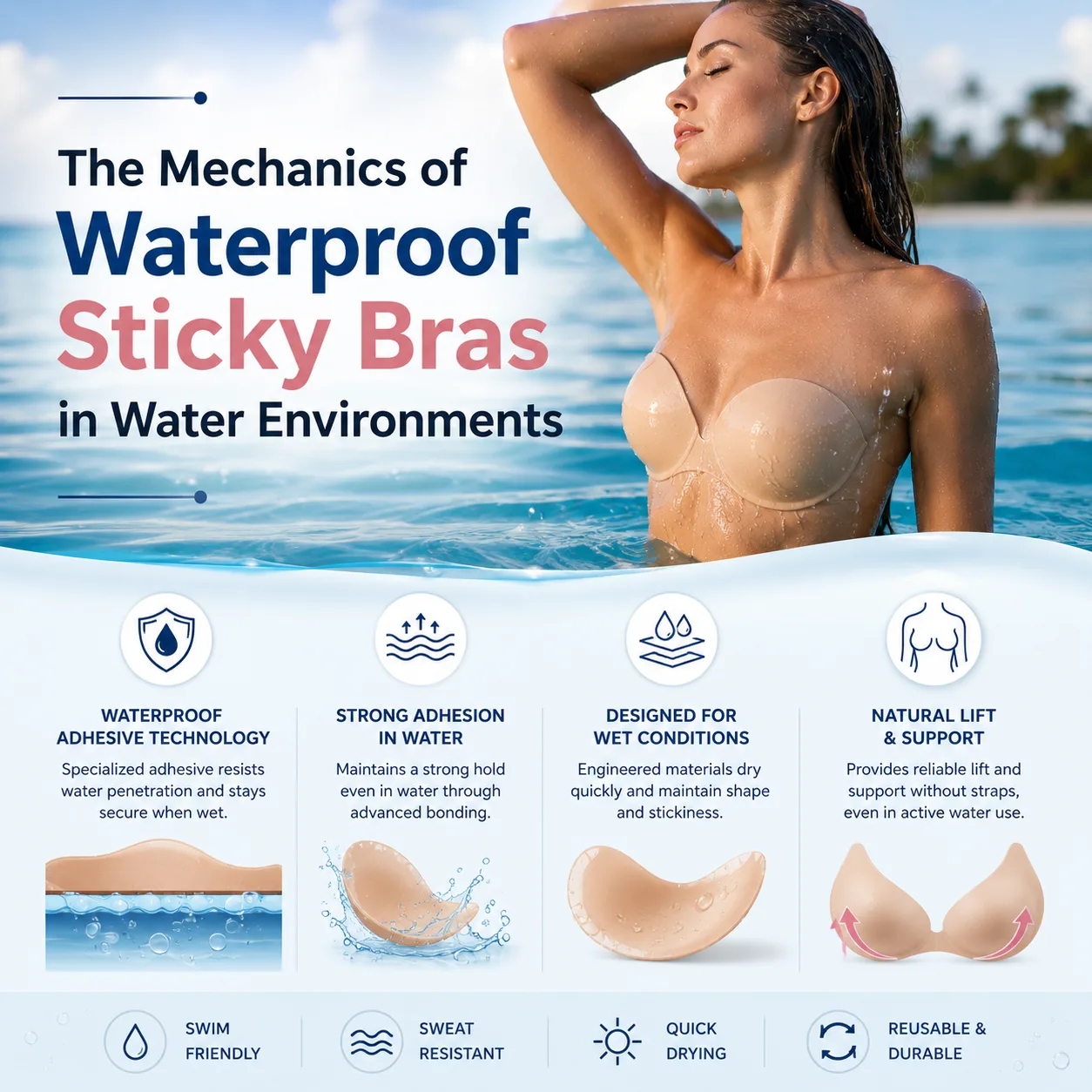
High-quality silicone functions as an engineering marvel in aquatic environments. At a molecular level, premium silicone is composed of a siloxane backbone—alternating silicon and oxygen atoms—shielded by hydrophobic methyl side groups. This chemical architecture creates an inherent resistance to water. Because water molecules are highly polar, they prefer to bond with each other rather than interface with the non-polar surface of the silicone polymer.
This high density and zero-porosity structure form a natural, impenetrable barrier. When pressed against the body, the silicone canvas does not absorb a single droplet. Instead, it forcefully repels moisture backward. This hydrophobic behavior ensures that water cannot seep through the body of the bra to compromise the internal state. The material remains entirely stable, maintaining its exact weight, structural shape, and elasticity whether it is dry on the beach or submerged three meters deep in a swimming pool. Lesser materials, such as cheap foam composites, act like sponges. They absorb water, increase in weight, pull away from the skin, and ultimately fail. High-grade silicone prevents this fluid migration entirely, keeping the interface between the skin and the undergarment completely dry.
The true frontier of aquatic lingerie engineering lies within the adhesive layer itself. Traditional fashion tapes rely on water-soluble acrylics that dissolve rapidly when exposed to moisture. In contrast, specialized swim-ready sticky bras utilize advanced, medical-grade pressure-sensitive adhesives (PSA), often formulated with cross-linked polymer matrices.
This specific adhesive chemistry relies on a physical bond rather than a chemical reaction. When applied with light pressure, the adhesive flows into the microscopic ridges of the human epidermis, creating a powerful vacuum seal. The cross-linked polymer chains are completely insoluble in water. They are specially synthesized to withstand the chemical aggression of chlorinated pool water and the high salinity of ocean environments. Even when exposed to these harsh elements, the adhesive matrix maintains its high viscosity. Crucially, this industrial-level endurance does not compromise dermatological safety. The formula remains hypoallergenic and biocompatible. It respects the sensitive nature of breast tissue, releasing cleanly from the skin without causing irritation once the physical vacuum seal is intentionally broken by the wearer after swimming.
Swimming is a dynamic sport defined by hydrodynamics and constant friction. As a body moves through water, it generates substantial kinetic drag. If a sticky bra has a thick, blunt edge, the oncoming water flow strikes that lip like a wave hitting a sea wall. This impact creates a high-pressure zone, forcing water underneath the perimeter and peeling the product away.
To survive these fluid mechanics, advanced manufacturing demands a gradient-tapered edge design. The bra must transition from a supportive center thickness down to an ultra-thin perimeter. This feathered edge allows the water current to glide smoothly over the surface without finding a purchase point. By minimizing hydrodynamic resistance, the risk of water lifting the edges during high-velocity movements, such as diving or executing a flip turn, is eliminated. The product moves in perfect synchronization with the skin, maintaining its physical seal through every stroke.
For brands seeking to offer these high-performance aquatic solutions, partnering with an experienced manufacturing facility is vital. With over 18 years of industry excellence, Dongguan Xinrui Underwear Co., Ltd. is a premier manufacturer of high-quality sticky bras, nipple covers, and bra inserts, certified by BSCI, ISO 9001, and the FDA. Our specialized production lines ensure that every waterproof sticky bra for swimming is built with precision, delivering the perfect balance of hydrodynamic design, reliable adhesion, and absolute comfort for consumers worldwide.
Curious about our quality? Request your free samples of nipple covers and sticky bras today. As a dedicated manufacturer, we provide unbeatable factory-direct pricing and service to ensure your brand’s success.

Dsaky
INQUIRY