
Products

Understanding the intersection of physics and lingerie requires a shift in how we view support. For decades, traditional backless options relied solely on surface tension. However, the introduction of the underwire sticky bra has fundamentally transformed the structural boundaries of backless garment design.
This innovation bridges the gap between gravity-defying aesthetics and genuine structural engineering, proving that strapless options no longer require a compromise on lift. For wholesale distributors and retail buyers navigating the evolving intimate apparel market, recognizing the mechanics of an underwire adhesive bra is essential for answering the growing consumer demand for targeted, dependable support.
At its core, an underwire sticky bra is an engineered balance between chemical adhesion and mechanical support. Unlike standard silicone cups that merely cover or compress the tissue, this specialized hybrid silhouette integrates a rigid or semi-rigid internal arc. This wire behaves exactly like its traditional counterpart, anchoring the bra against the inframammary fold.
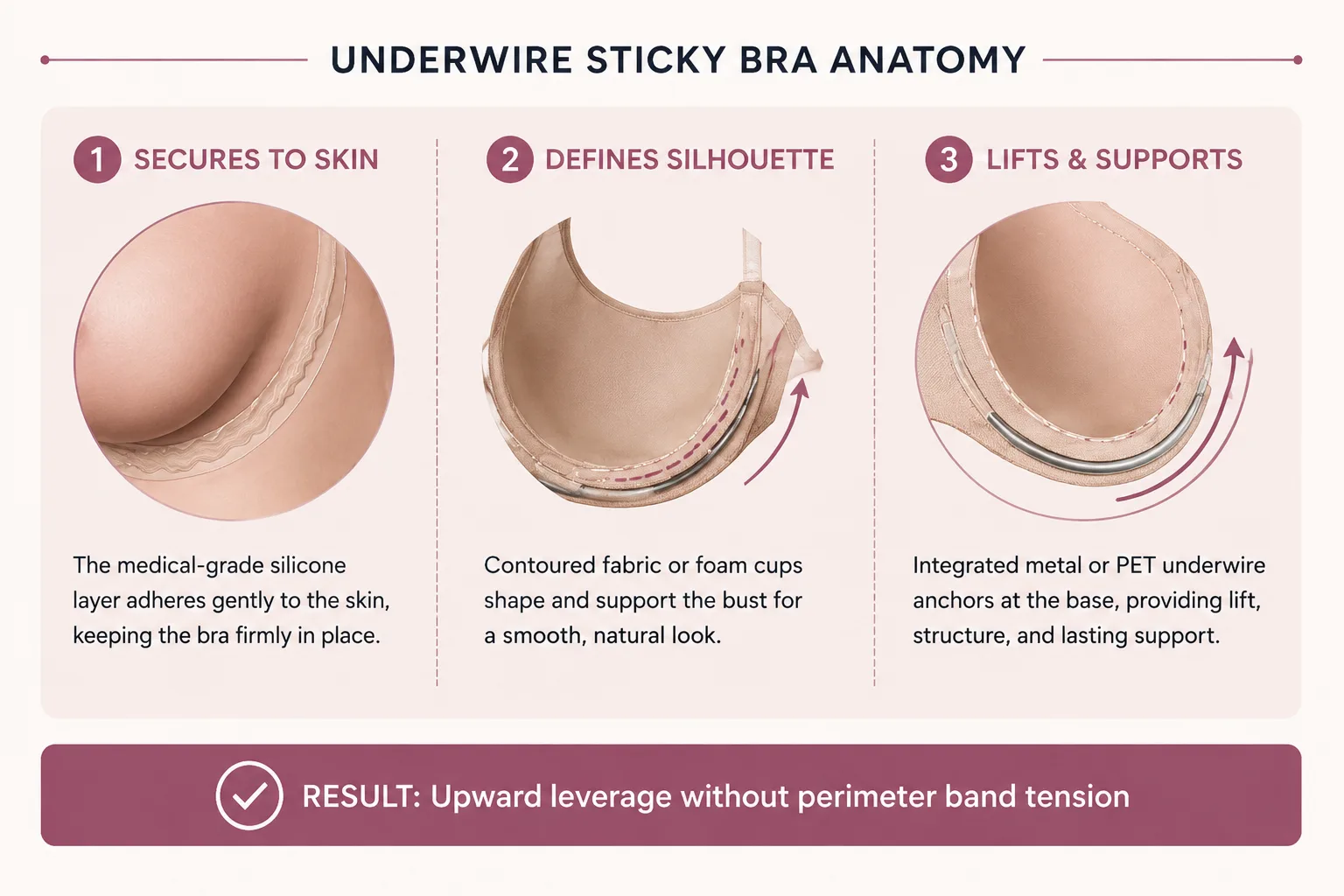
The magic lies in the suspension. In a standard bra, 80% of the support originates from the back band. When you remove that band, the law of levers dictates that gravity will pull the cup downward. By embedding a structural wire into a medical-grade adhesive chassis, the weight of the breast is redistributed across a wider surface area of the skin. This configuration creates upward leverage without relying on a tight perimeter band.
The distinction between wired and wireless adhesive options is structural, not cosmetic. Wireless sticky bras excel at compression, subtle coverage, and centering the breasts to create cleavage through lateral pulling force. They are soft, highly flexible, and mimic natural movement seamlessly. However, they lack vertical lift.
An underwire sticky bra focuses squarely on vertical elevation and separation. The integrated wire acts as a cantilever, holding its shape under the weight of the breast tissue. This prevents the cup from flipping outward or sliding downward under mechanical stress.
| Feature | Wireless Sticky Bra | Underwire Sticky Bra |
|---|---|---|
| Primary Mechanics | Lateral compression, surface adhesion | Vertical cantilever lift, skeletal anchoring |
| Tissue Separation | Minimal (tends to push breasts together) | High (defines individual breast root profiles) |
| Load Distribution | Concentrated on upper adhesive margins | Dispersed along the inframammary wire perimeter |
| Profile Yield | Soft, natural, slightly flattened profile | Projected, rounded, traditional molded profile |
For us, the stability of the adhesive under mechanical stress is a primary focus. When a wire introduces a rigid pivot point, the adhesive formula must feature higher cohesive strength to resist peeling forces at the edges.
The internal structure of a wired adhesive bra provides distinct advantages for specific body types. Women with fuller busts (D-cup and above) or those experiencing a loss of tissue elasticity find wireless adhesive cups inadequate because adhesive alone cannot counteract significant mass. The underwire provides a solid base that cups, holds, and elevates heavier tissue.
Furthermore, this internal architecture is crucial for garments with demanding necklines, such as deep plunging necklines, architectural square necks, and heavy satin bridal gowns. Heavy fabrics often compress the chest, but a wired adhesive bra maintains its internal space, keeping the silhouette intact under heavy or structured clothing.
A frequent misconception is that an underwire sticky bra must inherently be uncomfortable or prone to digging into the skin. In traditional lingerie, wire poke-through or digging is caused by an improperly sized back band shifting against the body. Because an adhesive bra bonds directly to the skin, shifting is virtually eliminated. When applied correctly, the wire sits quietly against the rib cage, distributed evenly by the surrounding silicone matrix.
Another myth is that the added weight of the wire causes the bra to slip off more easily. In reality, modern manufacturing utilizes lightweight, heat-treated spring steel or high-density PET polymers. These materials offer high tensile strength without adding noticeable weight. When paired with high-performance hypoallergenic glues, such as Germany’s Wacker adhesive, the structural integrity of the wire actually works alongside the adhesive, preventing the top edges of the cup from peeling forward.
Ultimately, navigating this category requires a deep understanding of structural balance. For brands looking to expand their intimate apparel lines, offering a well-engineered underwire sticky bra addresses a sophisticated consumer segment that demands both technical performance and invisible styling.
Curious about our quality? Request your free samples of nipple covers and sticky bras today. As a dedicated manufacturer, we provide unbeatable factory-direct pricing and service to ensure your brand’s success.

Dsaky
INQUIRY